|
|
- Simulations are due to Takashi Kanamaru
- This, and others talks, will be available on:
- www.sekine-lab.ei.tuat.ac.jp/~kanamaru /Chaos/e/Thompson/
- and
- www.culive.org/MichaelThompson @
|
|
|
- Part I
- 1 The Clockwork Universe of Newton
- 2 Chaos and Fractals
- 3 From Mayflies to Butterflies
- Part II
- 4 Chaos in Driven Oscillators
- 5 Fractal Basins and Chaotic Crises
- 6 Concluding Remarks
@
|
|
|
|
|
|
- 1.1 Double Pendulum: a taste of chaos (with HL)
- 1.2 The Quest to Predict the Future
- 1.3 Newton's Principia
- 1.4 Newton's Impact in Poetry and Art
- 1.5 Newton's Impact on Philosophy
- 1.6 The Clockwork Universe
- 1.7 The Simple Pendulum
- 1.8 Phase Space
- 1.9 Dissipation makes Attractors
@
|
|
|
- In mechanics, Newton's Laws allow precise analytical solutions to two
problems:
-
The simple pendulum
-
The Sun-Earth (two body system)
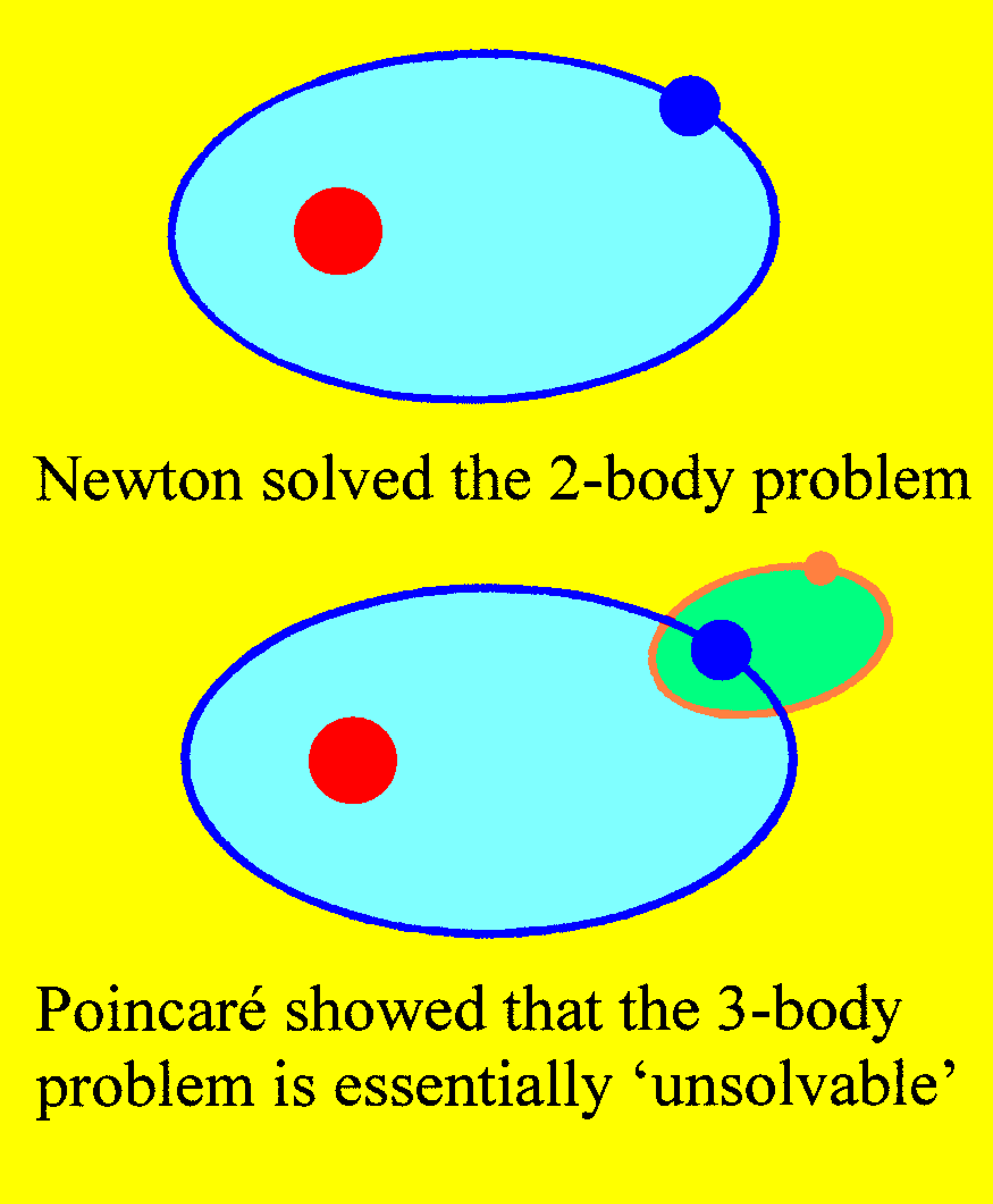
- One small increase in complexity gives the following, with chaos and no
such solution:
-
The double pendulum
-
The Sun-Earth-Moon (three body system)
- Click for double pendulum simulation
@
- d-pend
|
|
|
- This system conserves energy
- It is not dissipative
- Motions just continue, and do not settle
- Depending on the start it can exhibit:
- Regular oscillatory motion
- (upper left)
- Irregular chaotic motion
- (upper right, and lower)
- Click for Experiments
- E2 Double Pend (srb), 3m44s (2/3)
@
|
|
|
- Human beings have always sought to understand the working of nature
- Early in this search, astronomy proved to be a fertile field
- Early civilizations devised calendars to predict the seasons on Earth,
and the eclipses of the sun and moon in the sky @
|
|
|
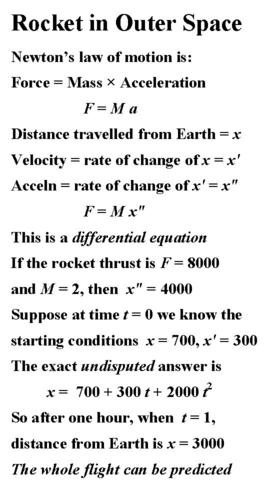
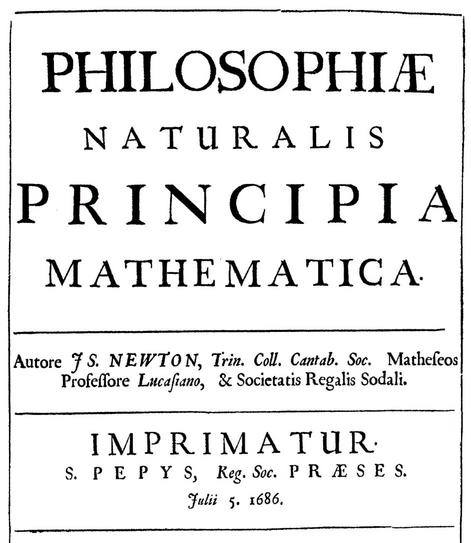
- In the year 1686, Newton's Laws of Motion revolutionised science
- They generate a dynamical system governed by a differential equation
- This is still the ideal way to model a system that evolves in time
- Given the starting conditions, a unique future can be predicted @
|
|
|
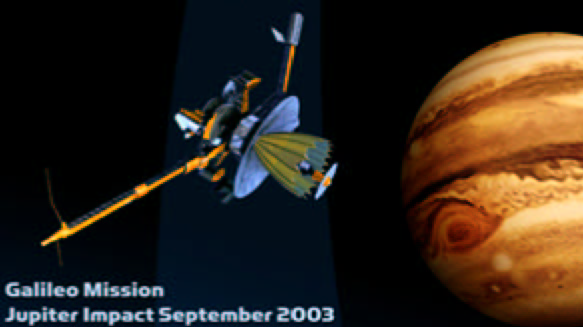
- Today, Newton's Laws are used throughout science and engineering
- In, for example, the design, the trajectory calculations, and the
guidance of the
- Mars missions
- They are superseded at the sub-atomic level by quantum mechanics:
- and at speeds near that of light, or at cosmic distances, by relativity
theory @
|
|
|
- Alexander Pope wrote:
- Nature and Nature's laws lay hid in night:
- God said, Let Newton be! and all was light
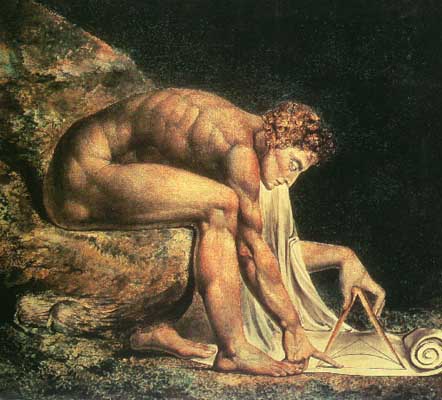
- Blake depicted him with divider and scroll
@
|
|
|
- Suppose the Universe is made up of particles of matter interacting
according to Newton's laws
- Then it is a dynamical system, governed by a (very large!) set of
differential equations
- Given the starting positions and velocities of all particles, there is a
unique outcome
- This type of argument was a bombshell to scientists and philosophers
- Pierre Laplace (1749-1827), a leading French mathematician, wrote
extensively about the clockwork universe
@
|
|
|
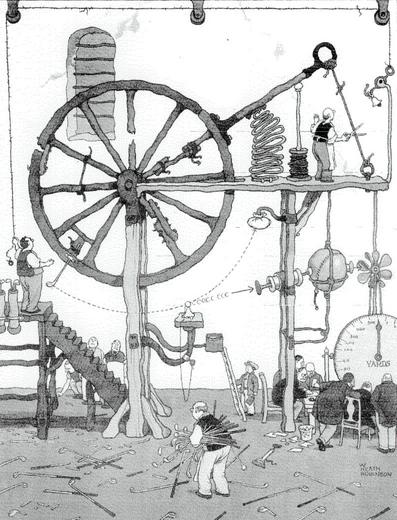
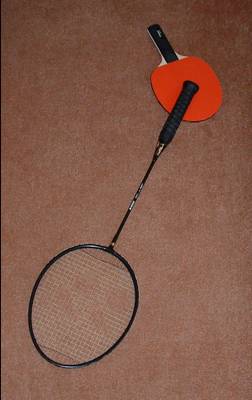
- Newton's Laws suggested
- that the Universe has the
- predictability of a machine
- Golf club testing
- by
- Heath Robinson
@
|
|
|
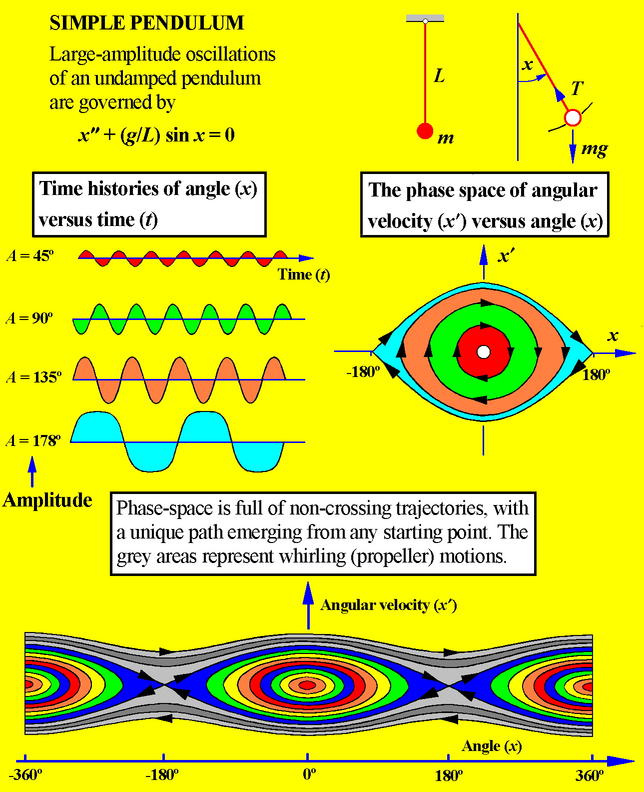
- The pendulum is a classical example of a dynamical system
- During a church service, Galileo pondered the constant oscillation of a
lamp swinging in the breeze
- Used for centuries in clocks, it is the very essence of regularity and
predictability
- Click for simulation
- Harm
@
|
|
|
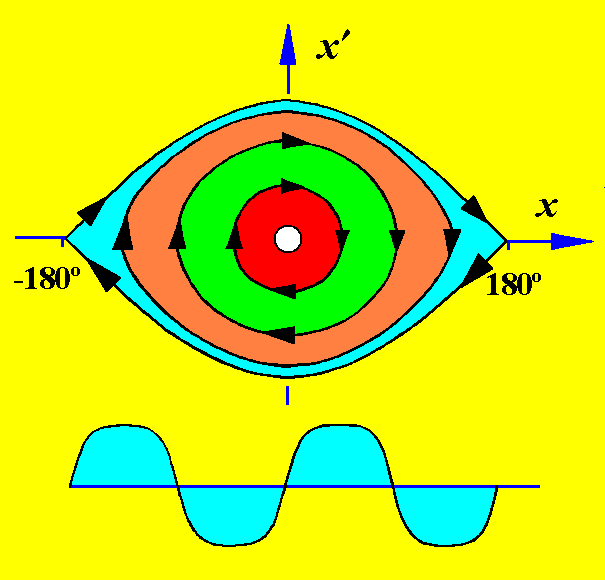
- Phase space is the space of the starting conditions
- It is full of non-crossing trajectories
- A motion, started at any point, has a unique path
- Phase space of a simple pendulum is in 2D
- Phase space of a double pendulum is in 4D
- Complex systems have hundreds of dimensions
- @
|
|
|
- The homoclinic orbit is the
- creator of chaos
- Imagine a very small number, E (say 1/1000000000)
- Release the pendulum at rest, and almost exactly upside-down, but just E
degrees off the vertical
- For years it will very slowly gather speed
- Today it will make a rapid transit of about 360º
- Then for years it will slow down, coming to rest at E degrees on the
other side of the vertical
- If disturbed, it may or may not get over the top @
|
|
|
- In a double pendulum the top pendulum effectively disturbs the bottom
one
- A mechanism for chaos is: the repeated passage near an unstable state +
a regular disturbance
@
|
|
|
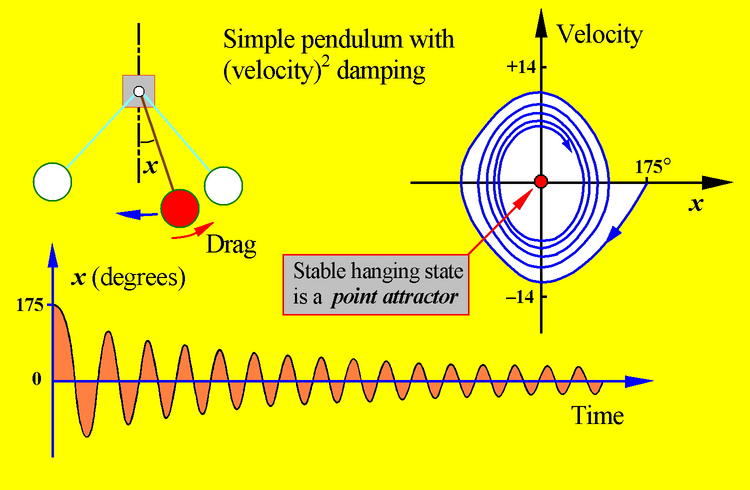
- The pendulum that we have been discussing is not realistic!
- It oscillates for ever, with no decay of its swinging amplitude
- The mathematical model that we used was incomplete
- We ignored friction in the bearing and air-drag on the bob
- Both of these dissipate energy and slow the pendulum down
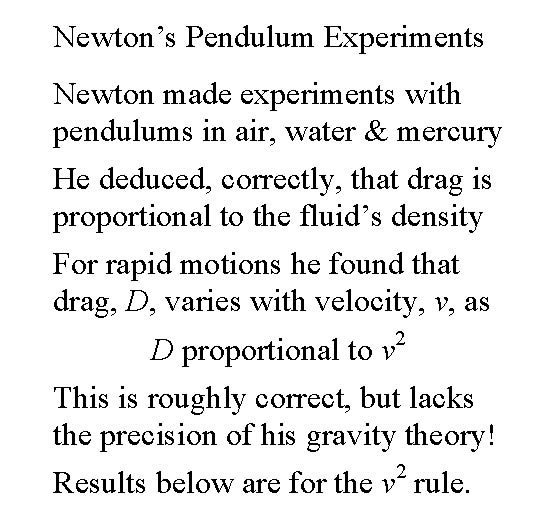
- Newton made experiments to estimate the drag force
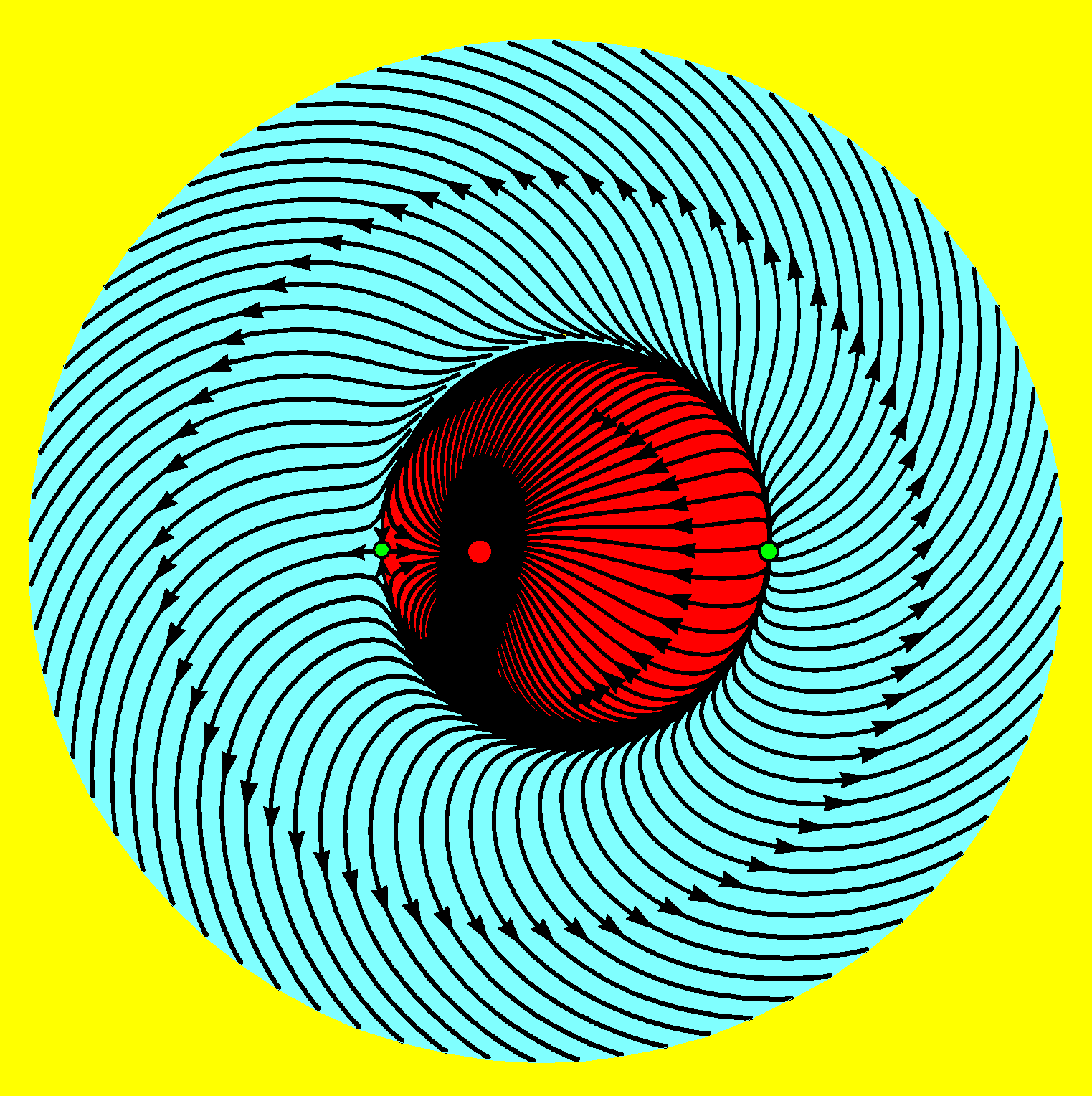
- Damping changes closed orbits into spirals to a point attractor
@
|
|
|
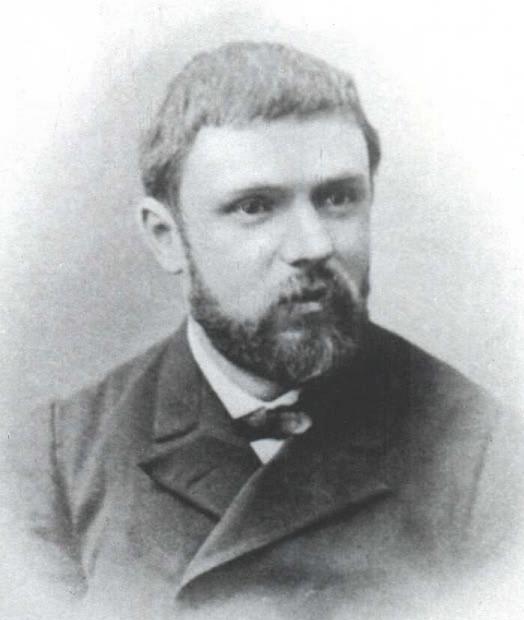
- 2.1 Henri Poincare
- 2.2 Lorenz Chaos (with HL)
- 2.3 Folding and Mixing
- 2.4 Rossler's Folding Band (with HL)
- 2.5 Poincare Section
- 2.6 Henon Map (with HL)
- 2.7 So what is a Fractal?
- 2.8 The Fractal Mandelbrot Set (with HL)
- 2.9 Another Fractal: Coastline of Britain @
|
|
|
- In 1887 the King of Sweden offered a prize to the person who could
answer the question "Is the solar system stable?"
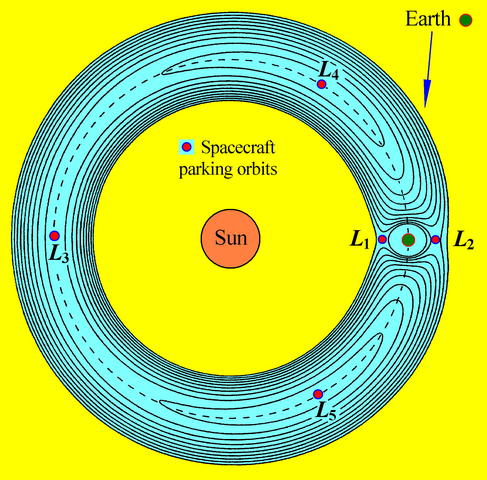
- Poincare, a French mathematician, won the prize with his work on the three-body
problem
- He considered, for example, just the Sun, Earth and Moon orbiting in a
plane under their mutual gravitational attractions
- Like the pendulum, this system has some unstable solutions
- Introducing a Poincare section, he saw that homoclinic tangles must
occur
- These would then give rise to chaos and unpredictability
@
|
|
|
- Rich dynamics of a chaotic state often allow it to be easily controlled
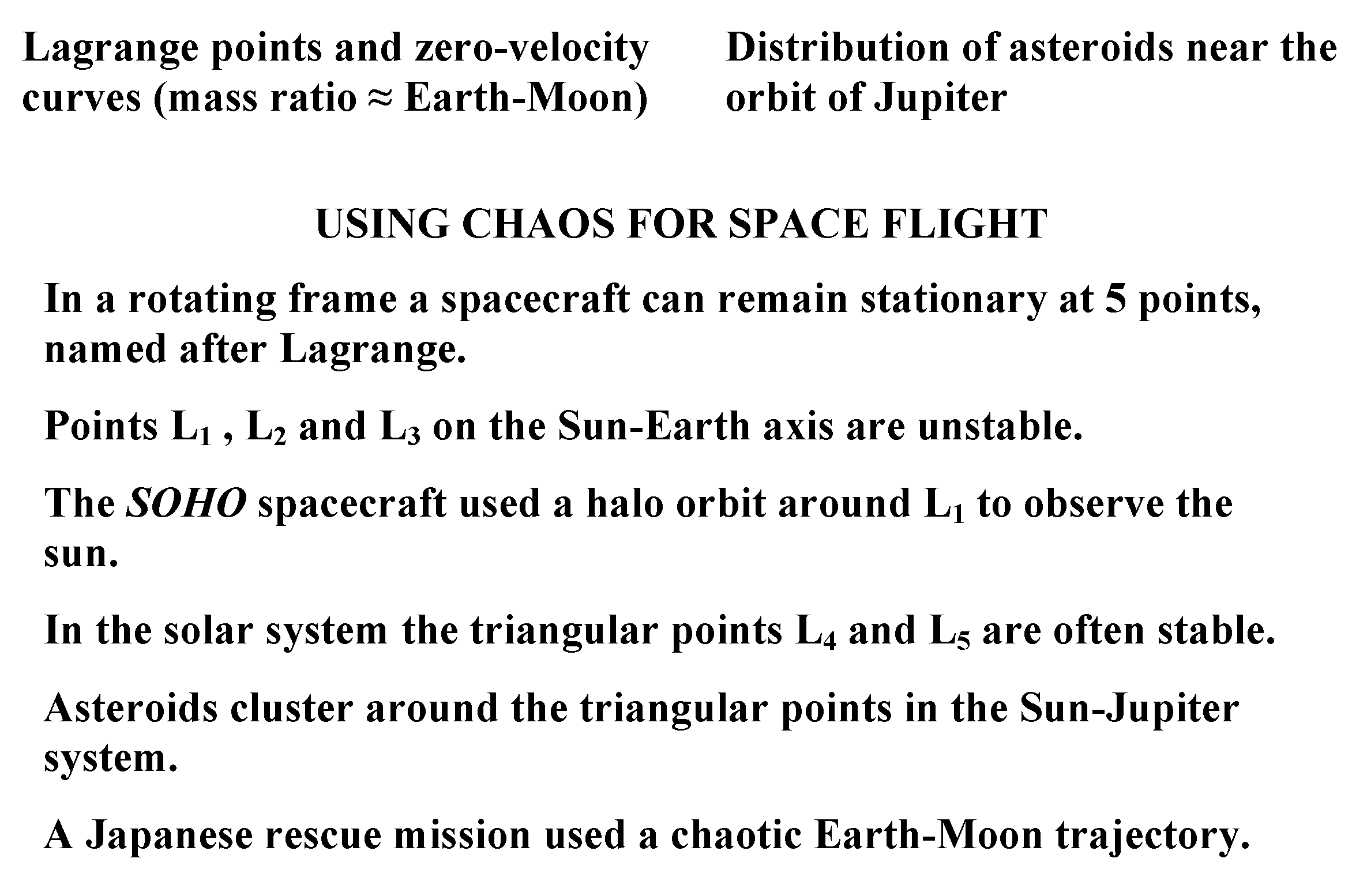
- Chaos is used by rocket scientists to minimise the fuel needed for a
mission
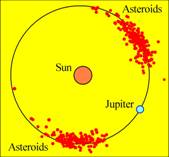
- To save Earth from destruction by an asteroid, it could be deflected
while in a chaotic regime @
|
|
|
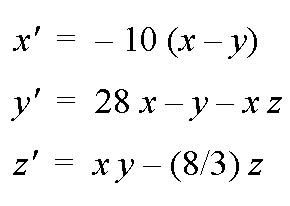
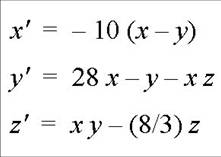
- In 1963 Lorenz was trying to improve weather forecasting
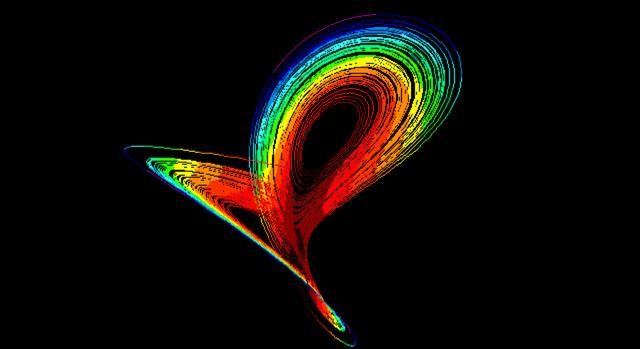
- Using a computer, he discovered the first chaotic attractor
- Three variables (x, y, z) define
convection of the atmosphere
- Changing in time, these variables give a trajectory in a 3D space
- From all starts, trajectories settle onto a strange, chaotic attractor
- Right and left flips occur as randomly as heads and tails
- Prediction is impossible
- Click for simulation
- lorenz
@
|
|
|
- This is a very simple system of equations with dissipation
- Like the damped pendulum, motions settle, but here to the chaotic
attractor shown
- This could not have been discovered without the computers that appeared
in the 1960s
- Since the solution is chaotic, it cannot be written down in any formula
- In a mathematical sense the problem is unsolvable
- All the computer does is solve the equations in an approximate way
@
|
|
|
- There is no crossing in phase space: so how do complex chaotic motions
arise?
- The answer is by divergence, folding and mixing (possible with nonlinearity
and 3D) @
|
|
|
- In 1976 Rossler devised a simple system to display the folding and
mixing of chaos
- Like Lorenz, this was a set of 3 first-order autonomous differential
equations
- Autonomous means there is no external forcing (time does not appear
explicitly)
- In the 3D phase space the repeated folding is like making flaky pastry
- This creates an infinite number of infinitely thin layers: a fractal
structure
- Click for simulation
- ross
@
|
|
|
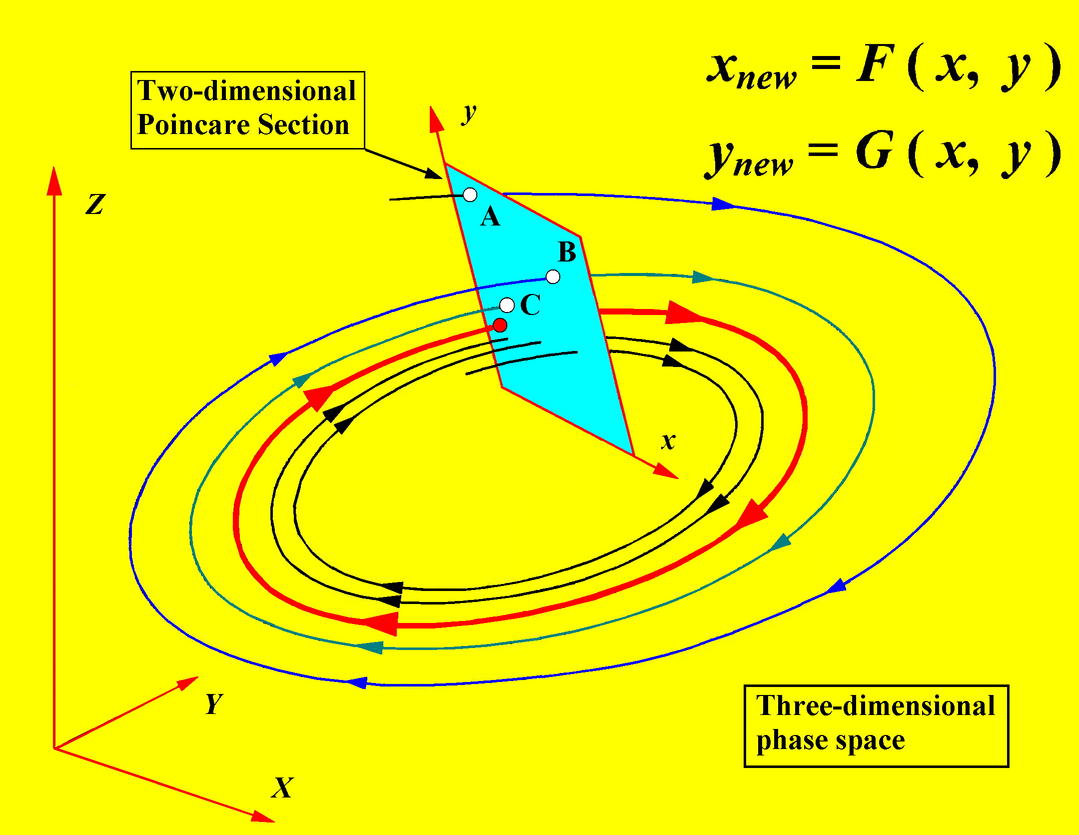
- To examine chaos, Poincare used the idea of a section
- This cuts across the phase-space orbits
- The original system flows in continuous time
- On the section, we observe steps in discrete time
- The flow is replaced by what is called an iterated map
- The dimension of the phase-space is reduced by one @
|
|
|
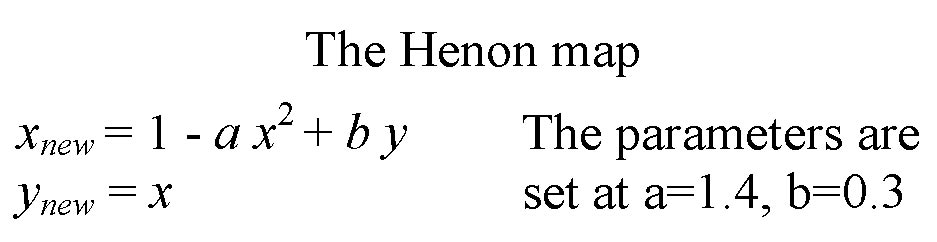
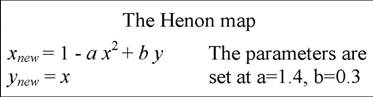
- To show what a Poincare section of chaos would look like, Henon devised
a simple 2D map
- Given any starting point, this map generates a sequence of points
settling onto a chaotic attractor
- In the simulation, we will now make repeated enlargements of the
attractor to see its fractal nature
- Click for simulation
- henon
@
|
|
|
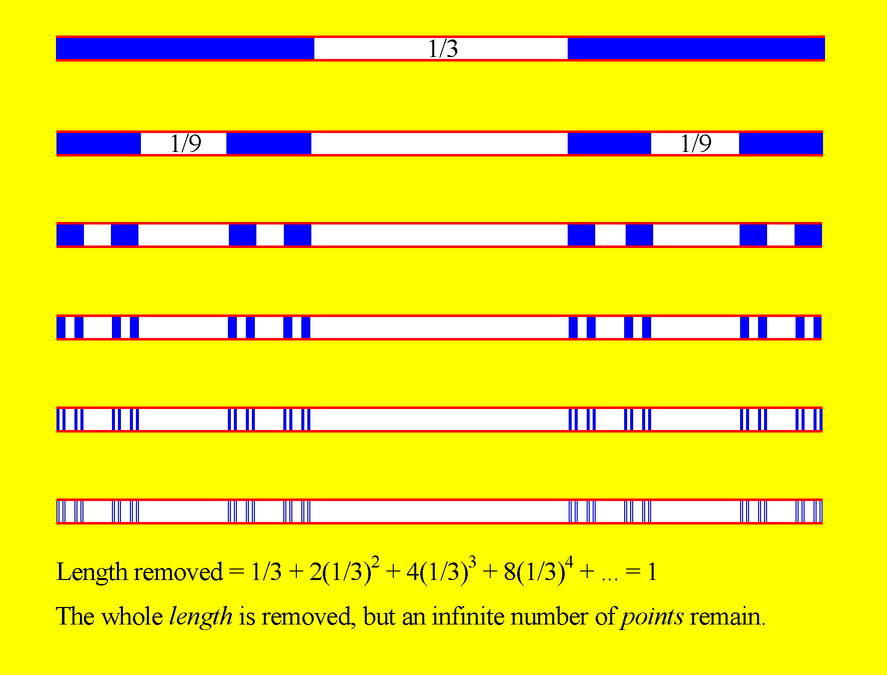
- The simplest fractal is the Cantor set
- Start with a line and take out the middle-third
- Then take out the middle-third of the remaining lines
- Repeat this process for ever, to get the Cantor dust !!
- A sheet has dimension D=2, a line has D=1, a point has D=0
- The Cantor set has the fractional value D=0.6309...
@
|
|
|
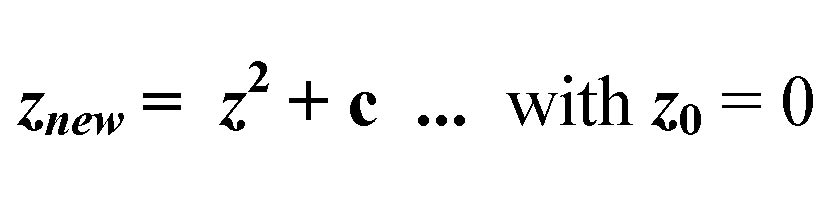
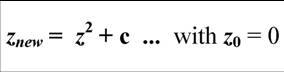
- Here z and c are complex numbers (with real & imaginary parts)
- For some values of c, the trajectory will diverge to infinity
- For others, it will converge (to fixed points, chaotic orbits, etc)
- Values of c giving convergence constitute the Mandelbrot set
- We view a plane whose axes are the real & imaginary parts of c
- The set itself will be coloured black
- Other points are coloured, depending on the rate of divergence
- Mathematically, the sequence of shrinking patterns never ends !!
- Click for simulation
- mand
@
|
|
|
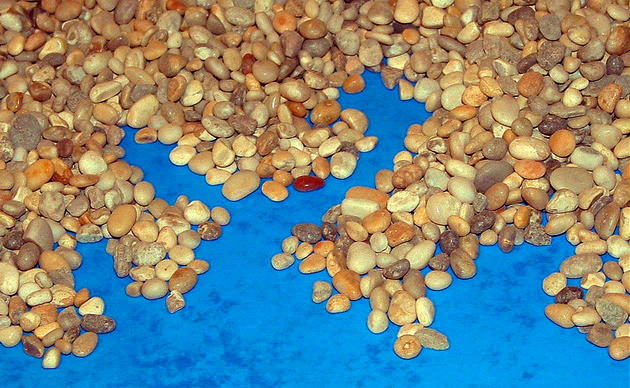
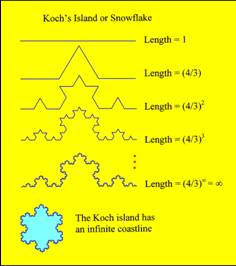
- The more detailed a map, the greater is the length estimate of a
coastline
- On the coast itself, a string would wind around every puddle, stone,
crack and molecule
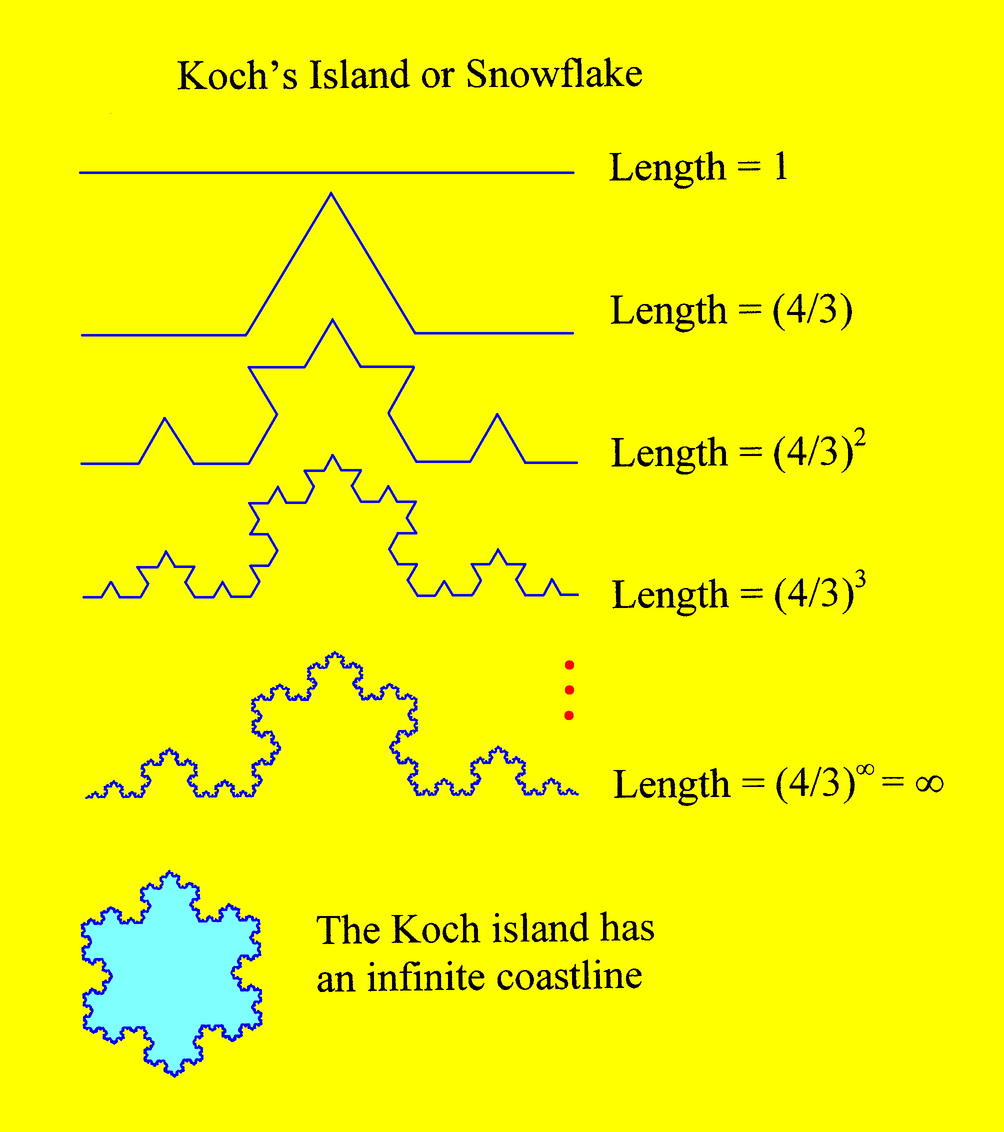
- To a good approximation the coastline is a fractal
- Using a divider of length A, the coastline tends to infinity as A goes
to zero
@
|
|
|
- 3.1 Population Growth
- 3.2 Chaos in Logistic Map (with HL)
- 3.3 Lorenz's Butterfly
- 3.4 Parable of Chaos
- 3.5 Logistic Cascade to Chaos (with HL)
- 3.6 Do some Dynamics at Home
- 3.7 Take a break!! @
|
|
|
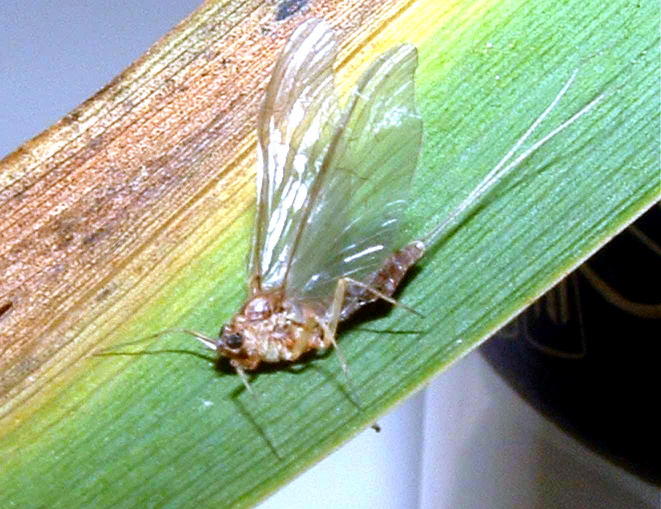
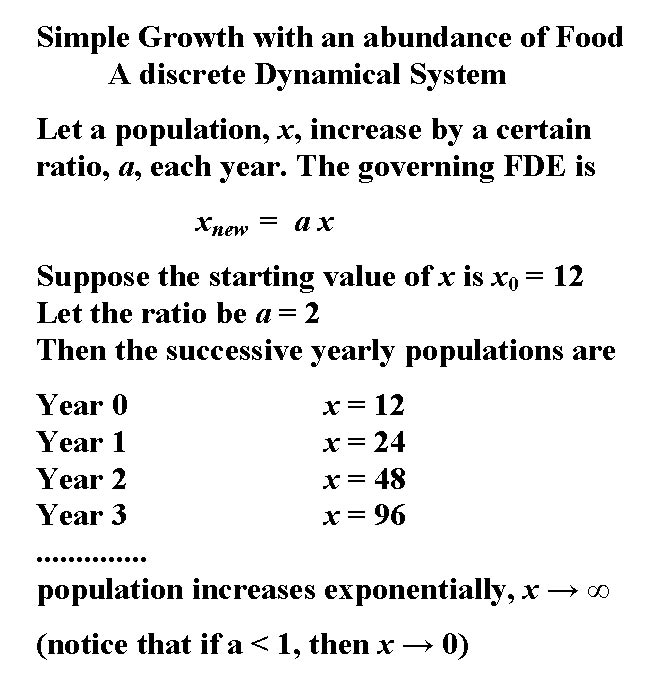
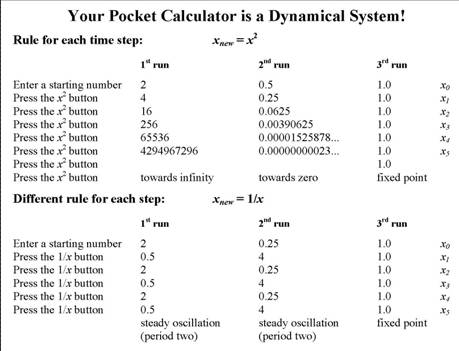
- In ecology we use a map for yearly steps between breeding seasons
- The more mayflies in a pond, the more offspring we expect next year
- A population that increases by a fixed ratio each year will explode!
- Applied to humans this result alarmed Thomas Malthus
- His Principle of Population (1798) influenced Darwin's thoughts on
natural selection
@
|
|
|
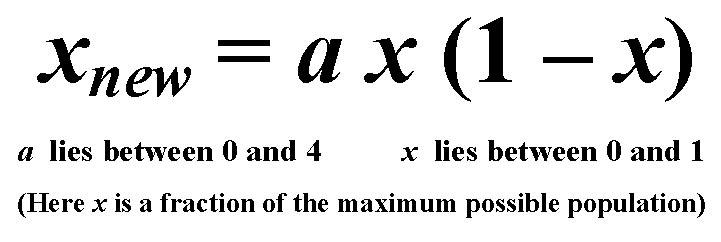
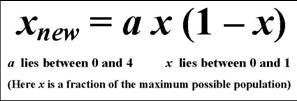
- An improved mathematical model of population growth is the Logistic Map
- The extra factor (1 - x) recognises the constraint of limited food
supplies, etc
- The current President of the Royal Society is Lord (Robert) May
- In 1976 he showed in the journal Nature how the logistic map gives rise
to Chaos!
- The future is unpredictable due to the sensitivity to initial
conditions: THE BUTTERFLY EFFECT !!!
- Click for simulation
- log
@
|
|
|
- Simple systems can have very complex behaviour
- This should be taught in schools!!
- Unfortunately text books concentrate on solvable problems, usually
linear (small amplitude) ones
- Why did it take 300 years from Newton to chaos?
- (1) There were no computers
- (2) Researchers were looking for order
- (3) Random results were thought to be wrong: so they ended up in the
waste paper basket
@
|
|
|
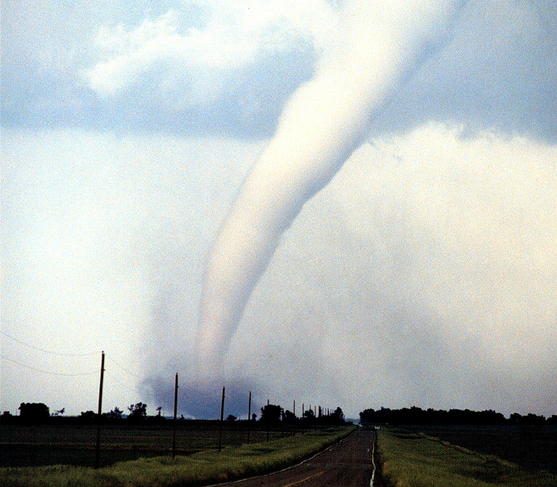
- The flap of a butterfly's wings in Brazil can set off a tornado in Texas
- This is a parable about sensitive dependence on initial conditions
- A tiny difference is amplified until two outcomes are totally different
- Due to inevitable chaos, long term weather forecasting is impossible
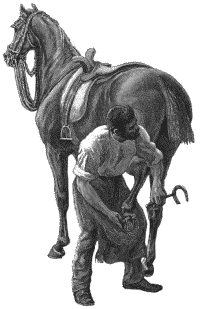
- For want of a nail, the shoe was lost!
@
|
|
|
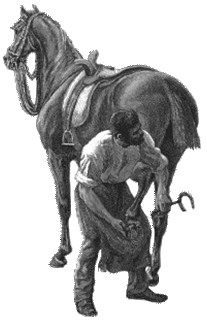
- For want of a nail
- the shoe was lost.
- For want of a shoe
- the horse was lost.
- For want of a horse
- the rider was lost.
- For want of a rider
- the battle was lost.
- For want of a battle
- the kingdom was lost.
- And all for the want
- of a horseshoe nail.
- (Benjamin Franklin) @
|
|
|
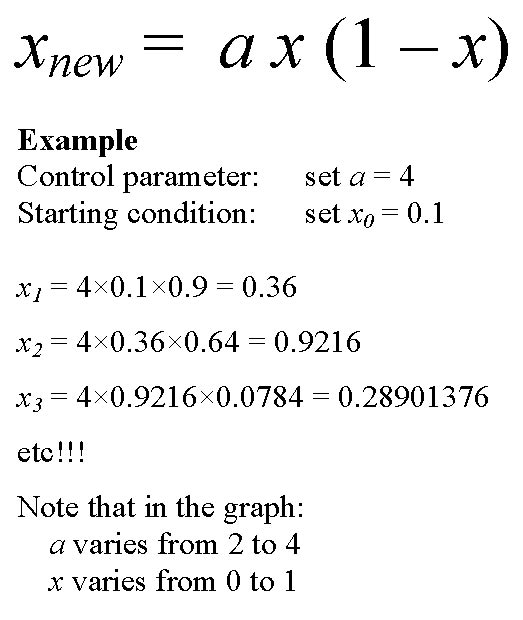
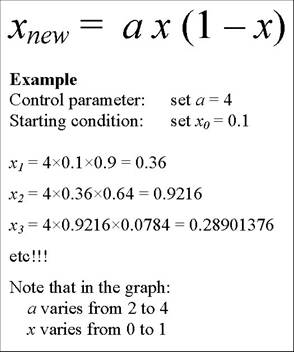
- The Logistic map applies the top equation repeatedly
- Steady state results are plotted as x against a
- A Feigenbaum cascade of bifurcations leads to chaos
- All cascades have smaller cascades within them
- The complex fractal pattern shrinks indefinitely
- Click for simulation
- bif
@
|
|
|
|
|
|
- I am reminded of a cartoon
- by Gary Larson in which a
- schoolboy in class is saying
- "Please Sir
- May I be excused
- My brain is full"
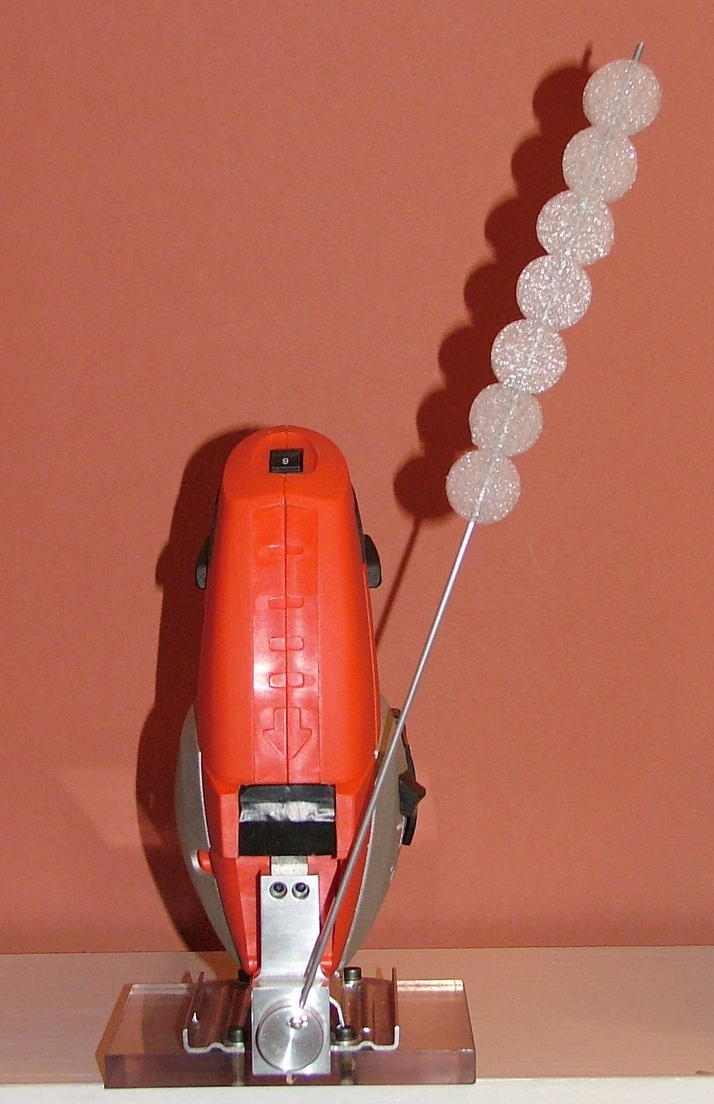
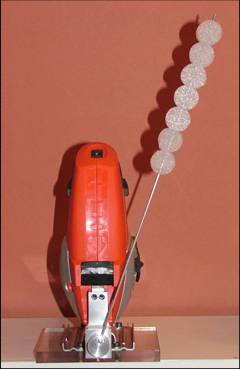
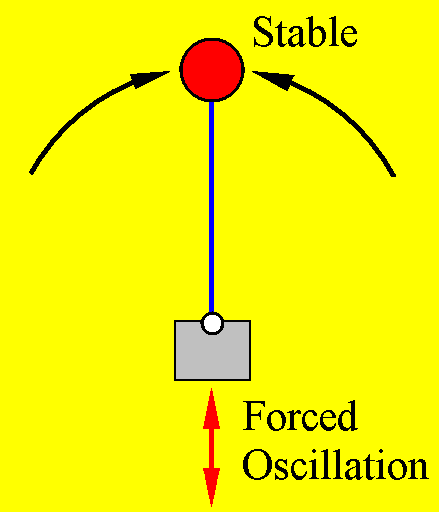
- After the break, in Part II of the talk we see the amazing balancing of
a pendulum mounted on a jigsaw as shown above.
-
End of Part I @
|
|
|
- Simulations are due to Takashi Kanamaru
- Click (forc2)
- This, and others talks, will be available on:
- www.sekine-lab.ei.tuat.ac.jp/~kanamaru /Chaos/e/Thompson/
- and
- www.xScite.com/MichaelThompson
@
|
|
|
- Part I
- 1 The Clockwork Universe of Newton
- 2 Chaos and Fractals
- 3 From Mayflies to Butterflies
- Part II
- 4 Chaos in Driven Oscillators
- 5 Fractal Basins and Chaotic Crises
- 6 Concluding Remarks
@
|
|
|
|
|
|
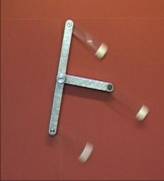
- The Traffic Cop is a system of
- pendulums that illustrates in a
- dramatic and amusing way the
- surprises and complexities of
- chaotic motion
- Click for Experiments
- E3 Traffic Cop (srb), 3m23s (0)
@
|
|
|
- 4.1 Some Driven Pendulums
- 4.2 Stroboscopic Section
- 4.3 Driven Pendulum: Chaos (with HL)
- 4.4 Driven Pendulum: Divergence (with HL)
- 4.5 Twin-Well Oscillator
- 4.6 Twin-Well Duffing: trajectory (with HL)
- 4.7 Twin-Well Duffing: moving cloud (with HL)
- 4.8 Twin-Well Duffing: settling to attractor (with HL) @
|
|
|
- A simple undamped pendulum swings forever. It has closed orbits in a 2D
phase space
- A simple damped pendulum settles to rest. Spirals lead to a point
attractor in a 2D phase space
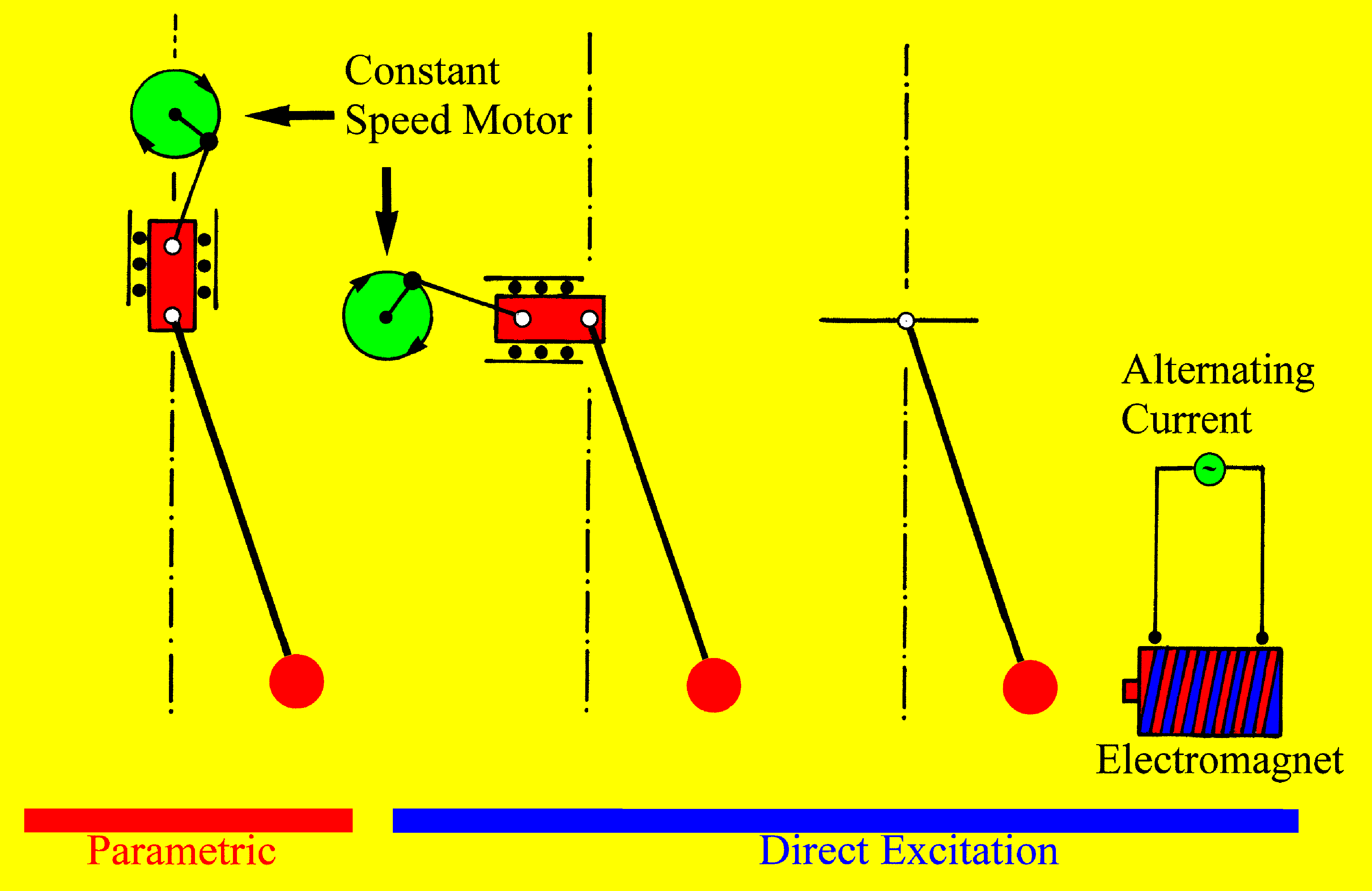
- A forced or driven pendulum has a 3D phase space, and can exhibit
chaos
@
|
|
|
|
|
|
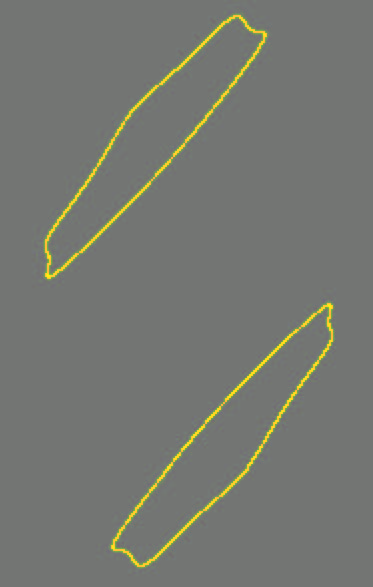
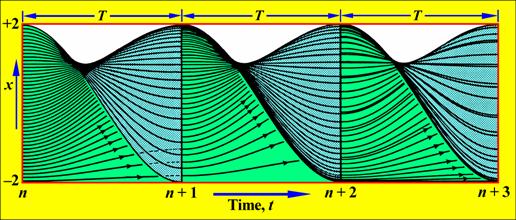
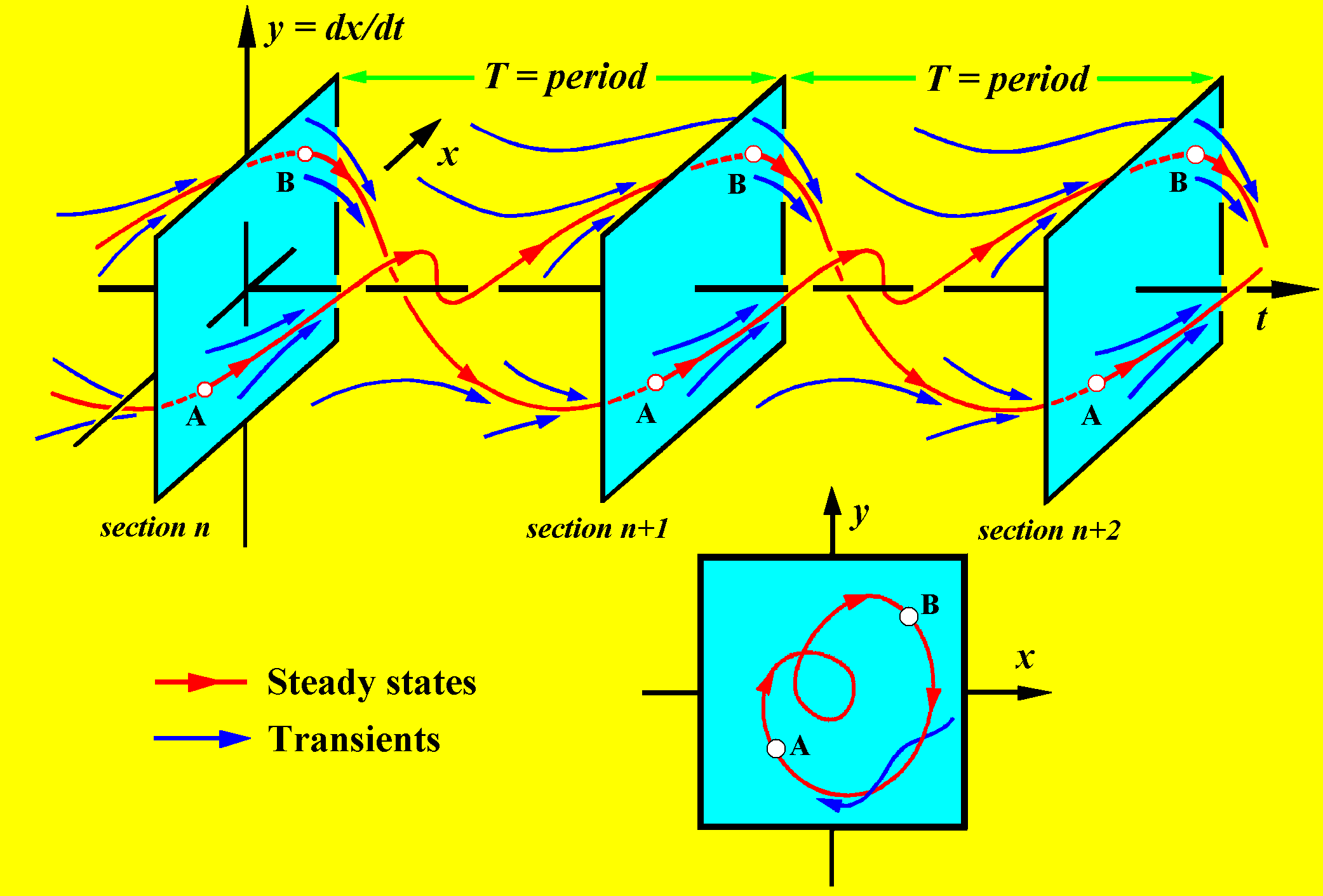
- A driven oscillator has a 3D phase space with displacement (x), velocity
(y), time (t)
@
|
|
|
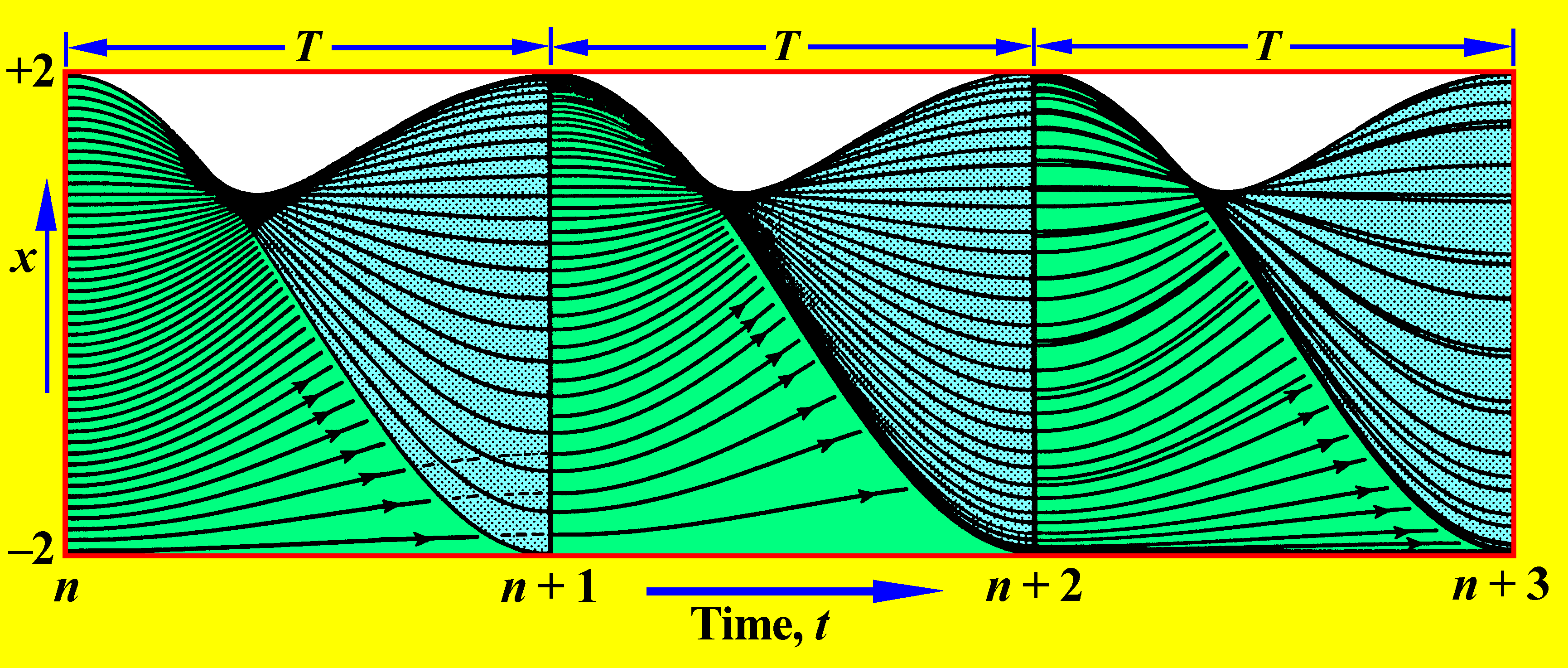
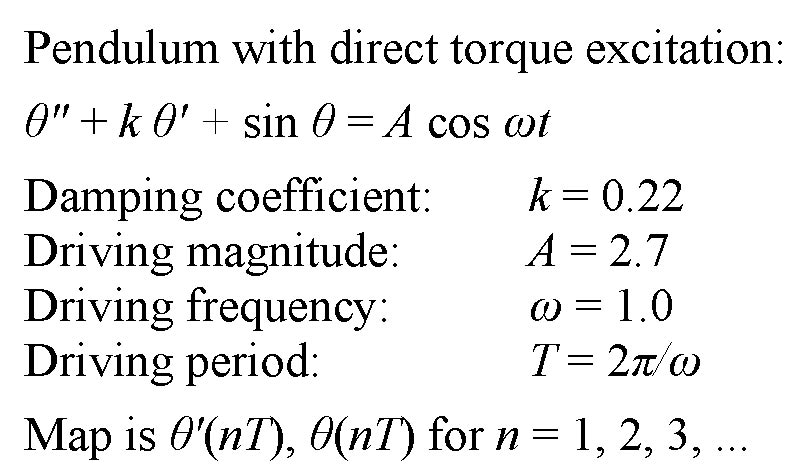
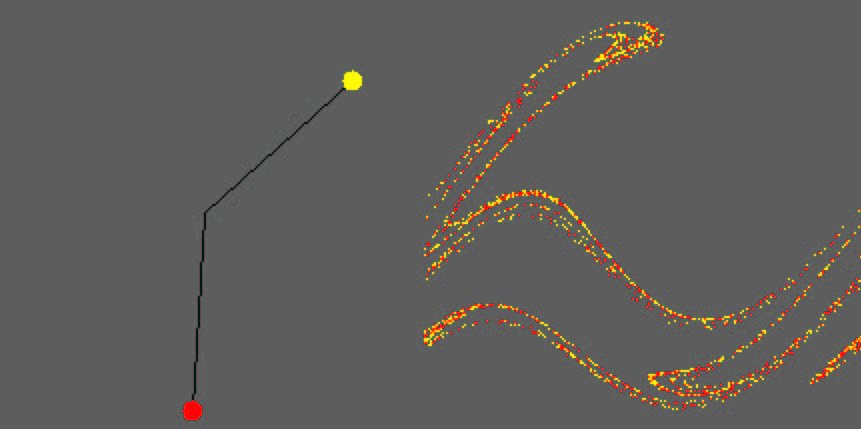
- Chaotic tumbling of a damped and driven pendulum
- In a stroboscopic section a strange attractor appears
- The two identical pendulums have slightly different starts
- Their motions separate, their sections remain the same
- We see ORDER in CHAOS
- Click for simulation
- forc2
@
|
|
|
- So how accurate is a computed trajectory?
- A computer solves an equation by taking short steps in time, and estimating
where the system will move in each step
- Put bluntly, it makes a small error at each step
- Unfortunately chaos magnifies small errors
- So a computed trajectory is basically unreliable
- We hope that, like our pendulums, the trajectory may be wrong, but the
attractor may be right
- Issues like this are still a research topic
@
|
|
|
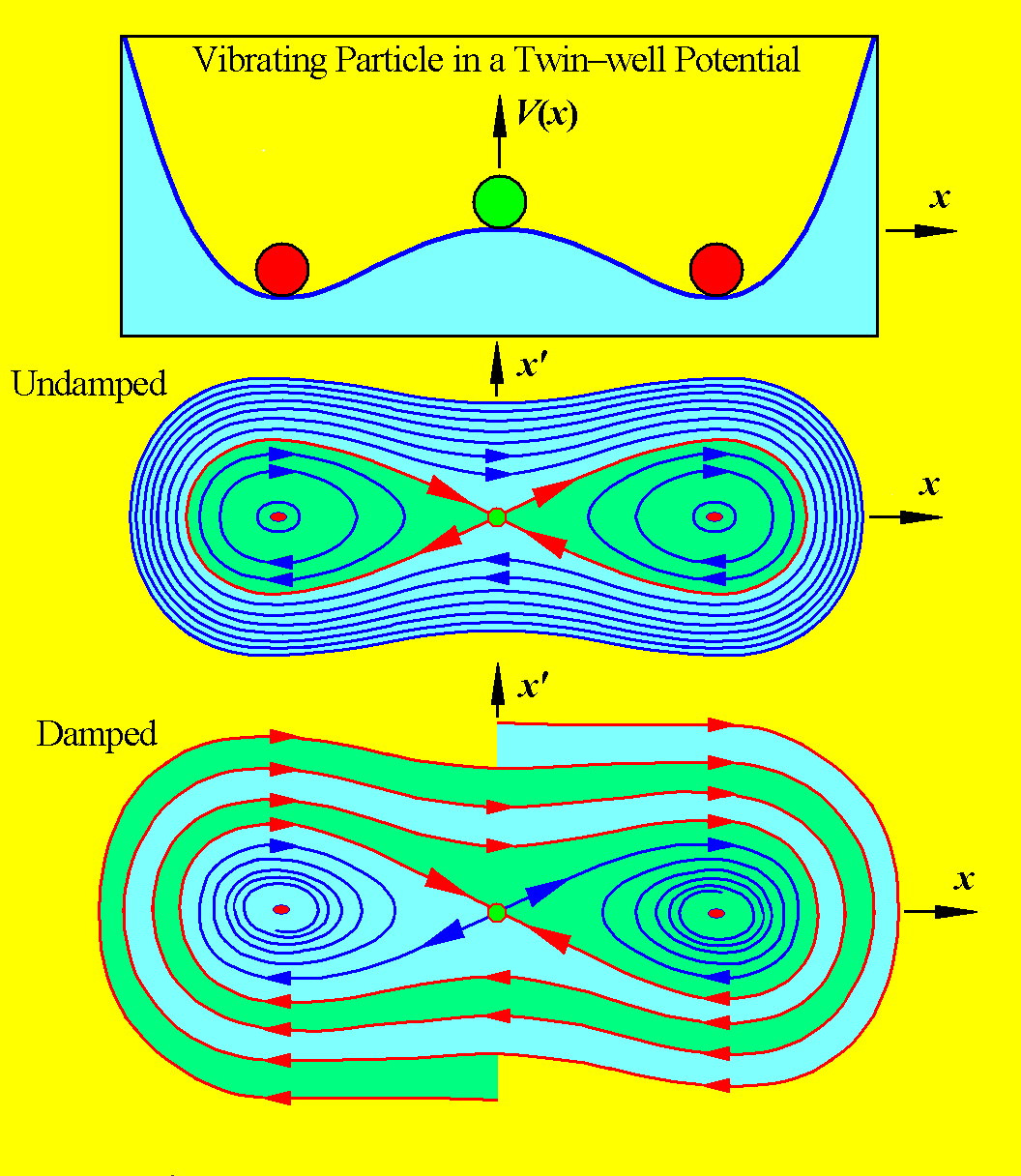
- Imagine a ball rolling on the top energy surface
- The undamped 2D portrait has closed orbits
- With damping we have 2 attractors in their basins @
|
|
|
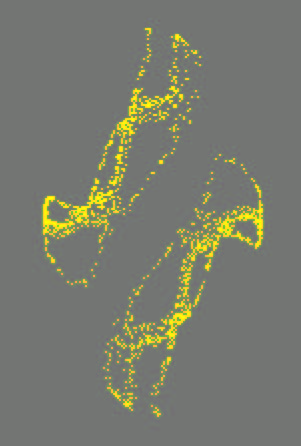
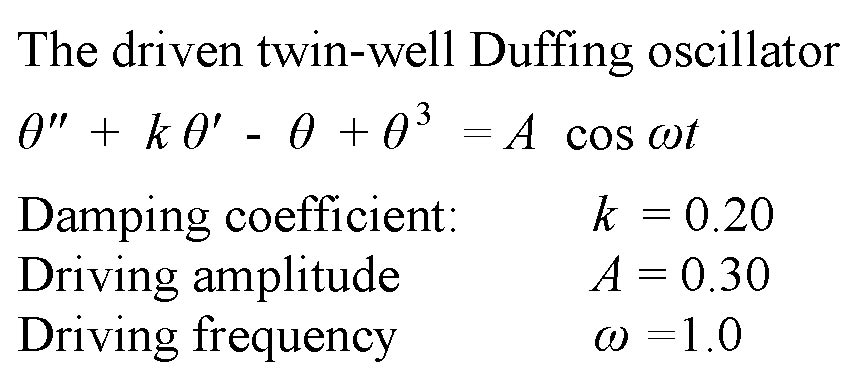
- Now imagine the ball-bearing is being pulled back and forth by a giant
alternating-current electromagnet
- Equations like this are named after Duffing
- Stroboscopic sampling of the steady state gives:
|
|
|
- We have seen how stroboscopic sampling gives us the familiar fractal
picture of the chaotic attractor
- We can learn a lot about the stretching, folding and mixing of chaos by
looking at intermediate sections
- These can be assembled into a movie, showing the distortions of the
attractor as we move through time.
- Click for simulation
- cloud only (Mpeg) (all)
@
|
|
|
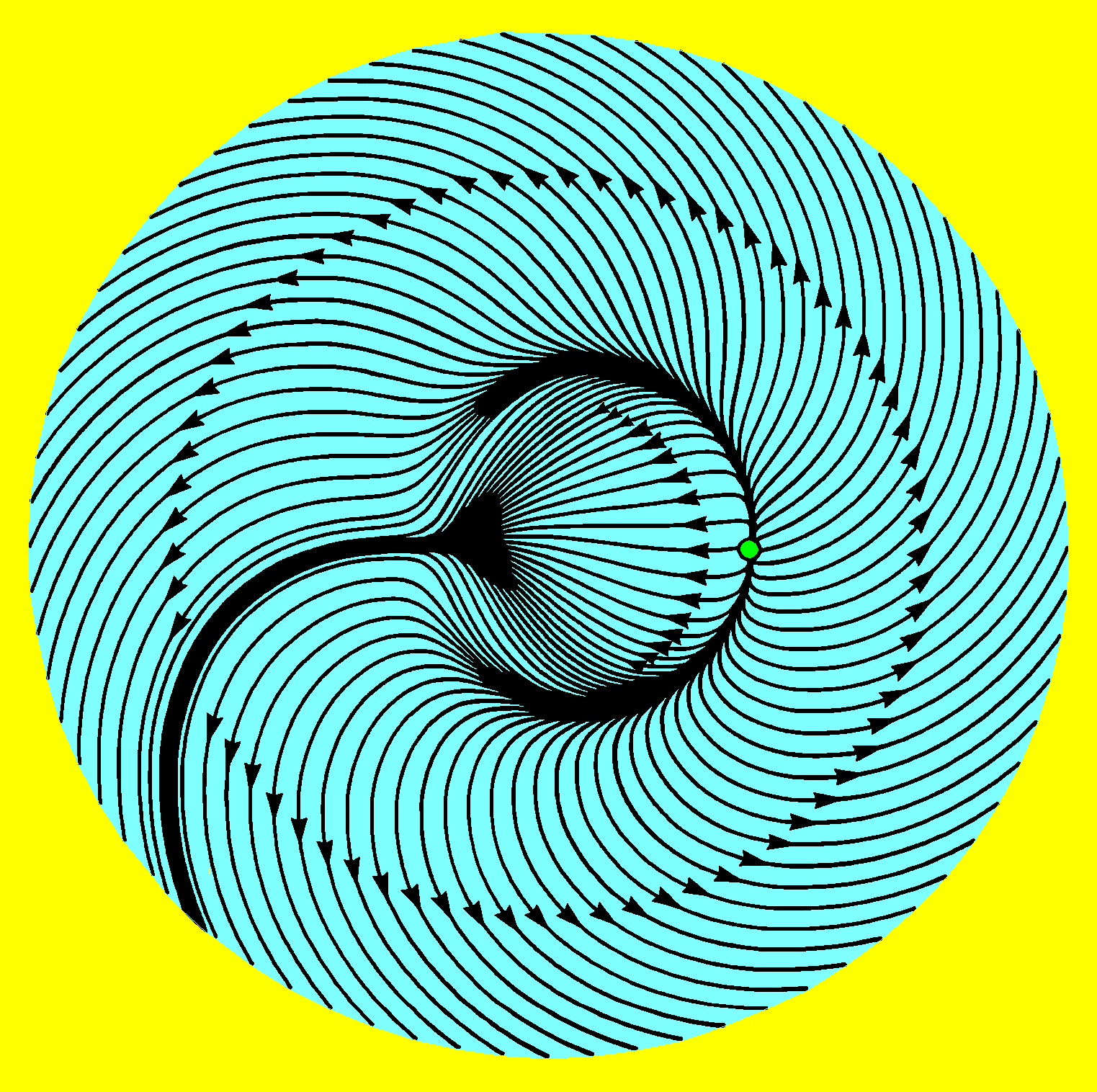
- For the damped, undriven pendulum we saw how trajectories spiral into a
point attractor
- This point attractor is the stable hanging state of the simple pendulum
- We shall now see how nearby trajectories are attracted into the stable
chaotic motion of the driven twin-well oscillator
- Click for simulation
- duff-transient
@
|
|
|
- 5.1 ABC of Nonlinear Dynamics
- 5.2 Escape from a Well
- 5.3 Homoclinic Tangling
- 5.4 Fractal Basin Erosion (with HL)
- 5.5 Chaos in Crisis
@
|
|
|
- Key concepts of dissipative dynamics are:
- Attractor
- Basin
- Catastrophe (bifurcation)
@
|
|
|
- A given system can have many attractors of different types
- Each sits in its own basin of attraction
- The attractor chosen depends on the starting conditions @
|
|
|
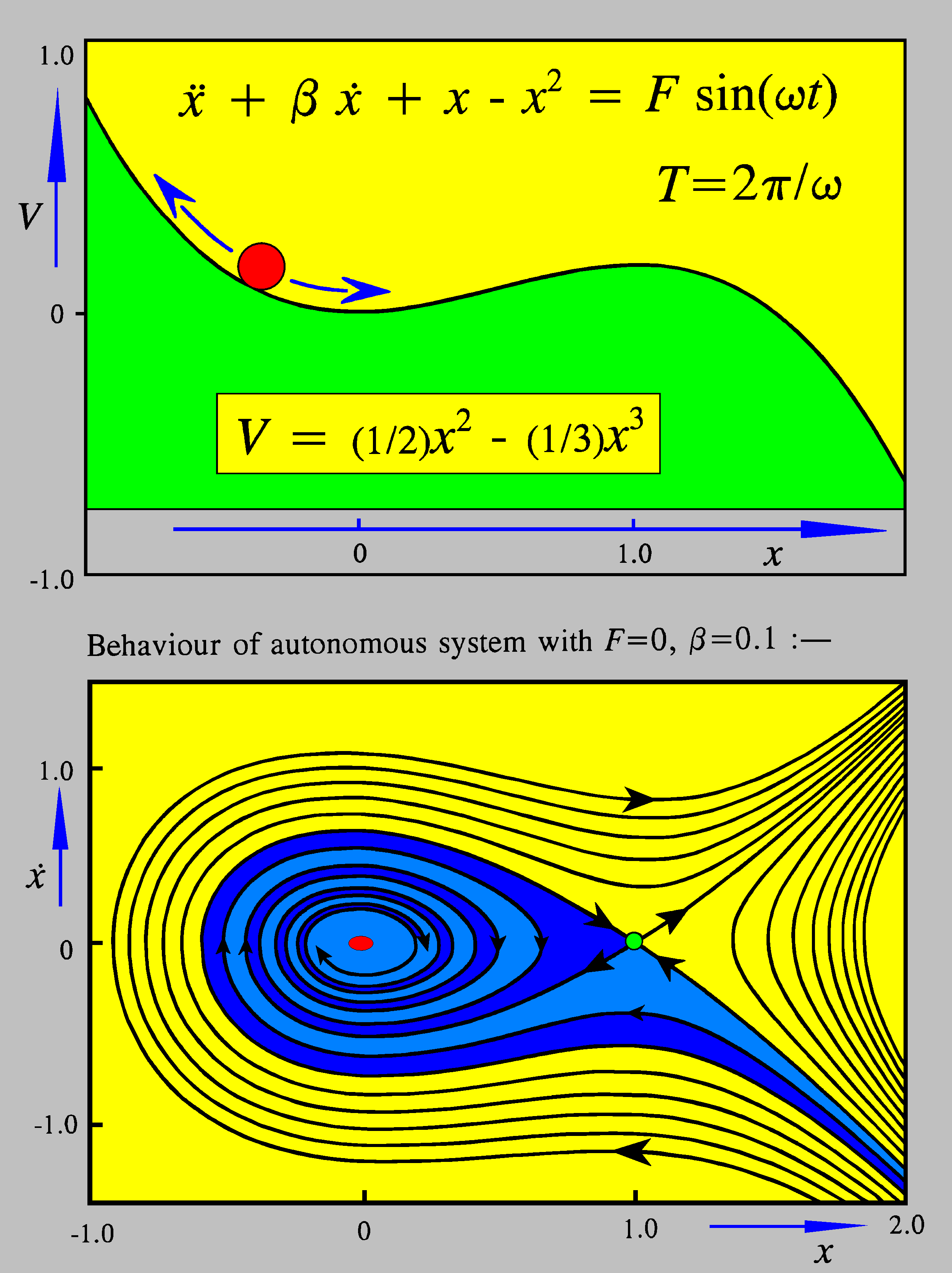
- Escape from a potential well is a recurring problem in science and
engineering
- Consider a damped particle in a well excited by a direct periodic
driving force
- If the driving is switched off, the 2D phase portrait is as shown in the
lower picture
- The safe basin of attraction is shown in white
- Starts in the grey area escape over the hilltop to infinity
@
|
|
|
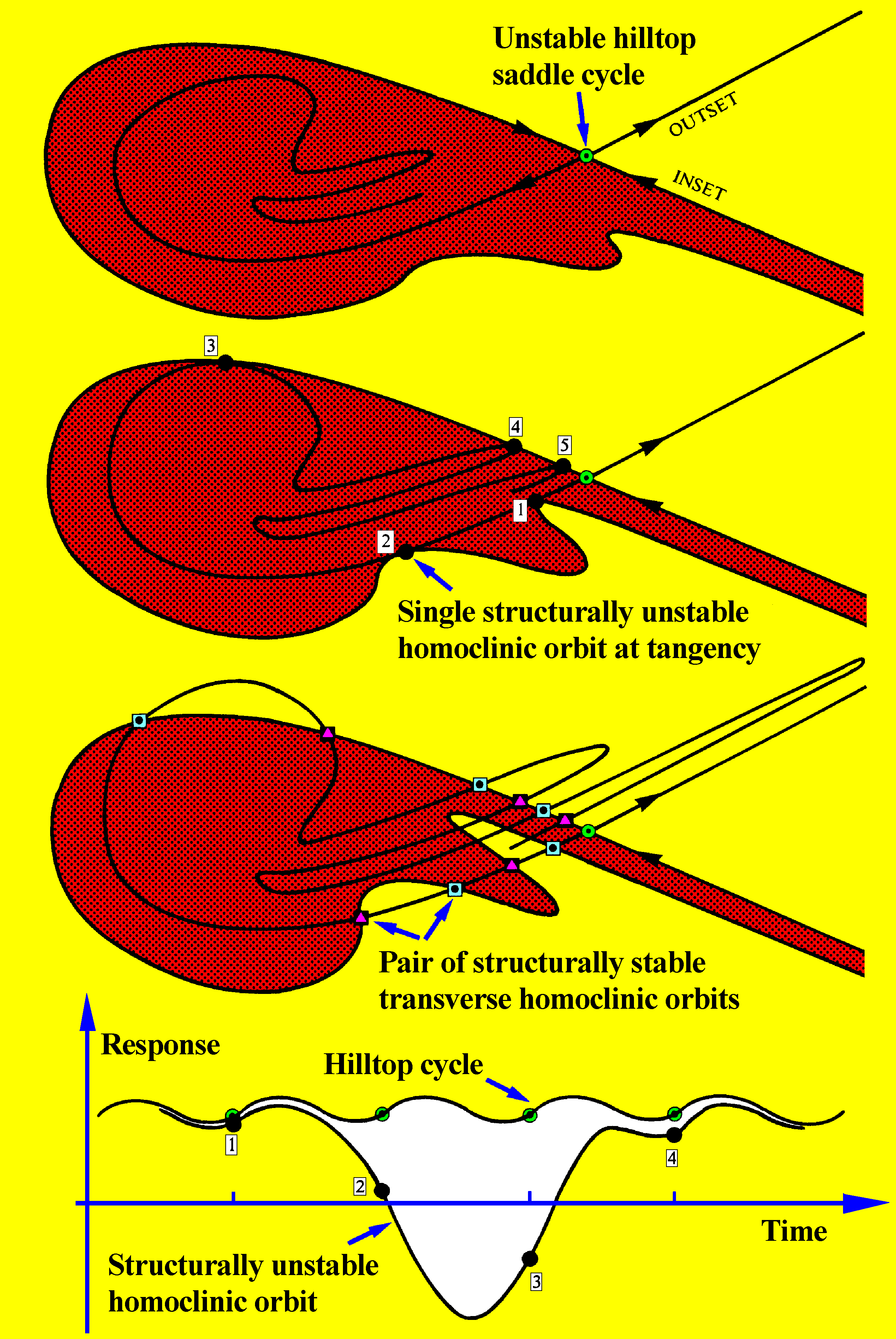
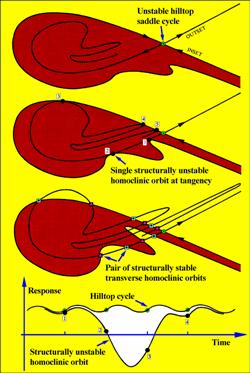
- Once we start driving, the phase portrait is in 3D
- We must view the basin in a stroboscopic section
- The hill-top solution still has an inset and an outset
- Solutions step along these lines (unlike the flow in 5.2)
- As the driving increases, the inset and outset get tangled
- They intersect one another an infinite number of times
- The boundary of the safe basin becomes fractal
@
|
|
|
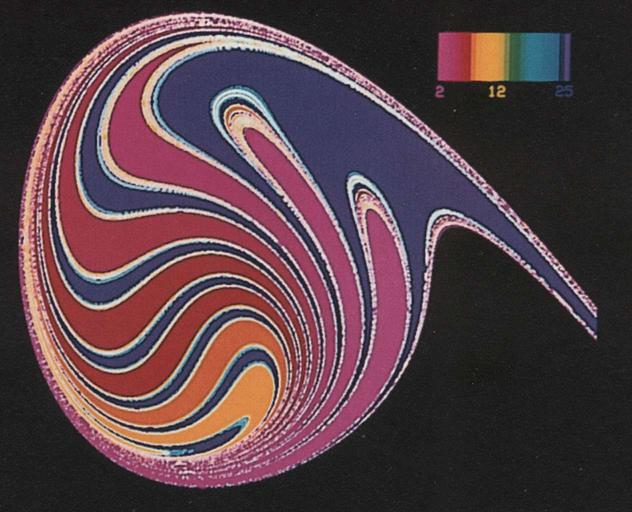
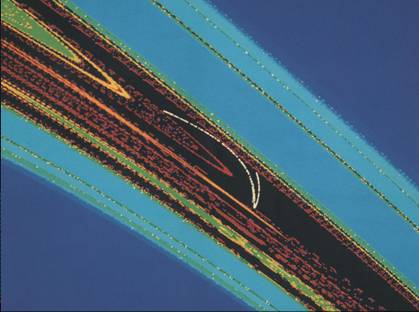
- As the driving increases, fractal fingers created by the homoclinic
tangling make a sudden incursion into the safe basin: the integrity of
the in-well motions is lost
- Colours show escape time, measured in driving periods
- Click for Simulation (made by Prof Joseph Cusumano)
- Cusu 2m28s (1/2+) @
|
|
|
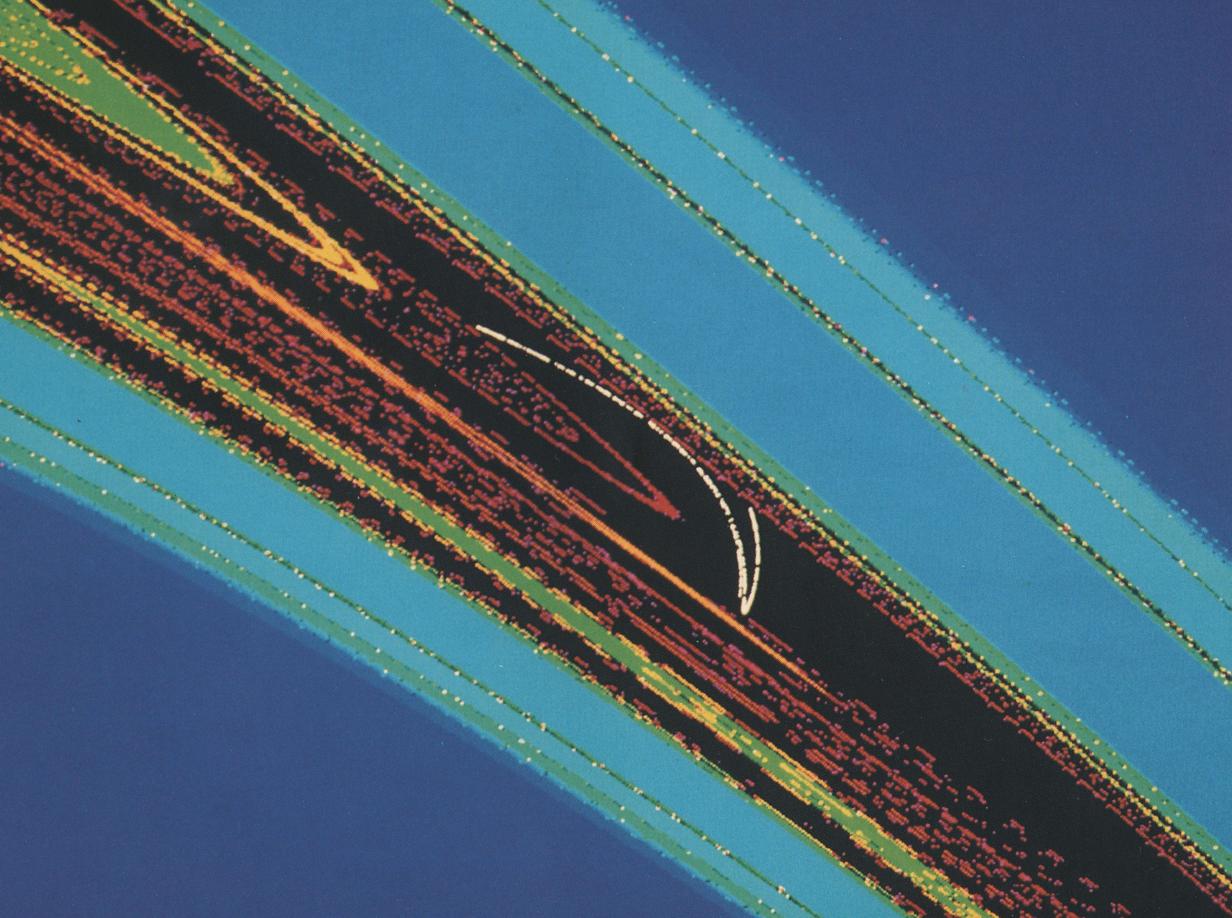
- The white chaotic attractor is about to vanish as it collides with its
fractal basin boundary
- At such a crisis the attractor disappears. The system jumps to a
different state: ours jumps out of the well ! @
|
|
|
- 6.1 Chaos and Mathematical Models
- 6.2 Properties of Chaos
- 6.3 Where has chaos been found or used?
- 6.4 Conclusion (with HL)
@
|
|
|
- Chaos is a random output from equations which have precise deterministic
rules
- It exhibits extreme sensitivity to initial conditions
- Chaotic solutions are mathematically unsolvable
- Computations are prone to enormous errors
- Detailed prediction impossible
- However there is order within chaos @
|
|
|
- The butterfly effect makes detailed prediction impossible
- However there is order within chaos
- Chaotic attractors are stable and there is no danger of a sudden
excursion off the attractor
- An engineering system in a chaotic state is not necessarily dangerous: it
might have advantages @
|
|
|
- PHYSICS
- Particle accelerators Quantum mechanics
- Turbulence and convection
Lasers, nonlinear optics
- ASTRONOMY and EARTH SCIENCE
- Gaps in the asteroid belt
Tumbling of Hyperion
- Earth's magnetic reversals Weather and
climate
- CHEMISTRY
- Atomic & molecular dynamics Pattern formation
- Flames and combustion Reaction kinetics
- BIOLOGY and MEDICINE
- Populations, natural selection Disease epidemics
- Irregularities of the heartbeat
Brain rhythms
- ENGINEERING and ELECTRONICS
- Flight dynamics in air and space Capsize of ships
- Actuators, controls and gears Electronic circuits
- Communications, encryption Power supply, black-outs @
|
|
|
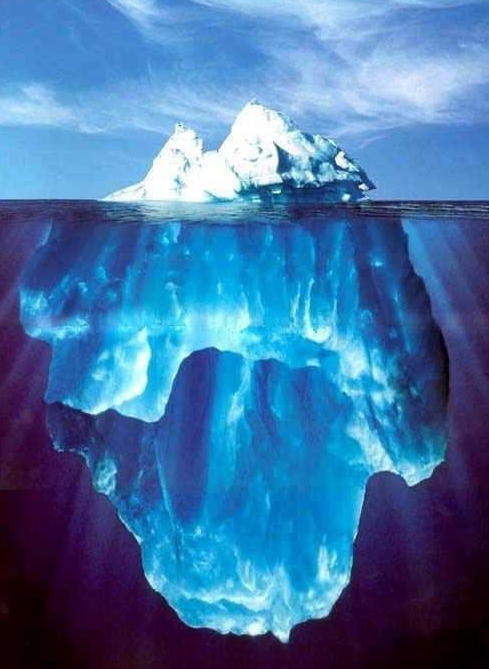
- In this 2-Part talk we have seen
- just the tip of chaos theory
- It is said that human brains
- work best in a chaotic state
- So if your brain is in chaos,
- the lecture was a success!
- Click (brain) for simulation
- of chaos in a neuron
- For this and other talks see:
- www.culive.org/MichaelThompson
- and
- www.sekine-lab.ei.tuat.ac.jp/~kanamaru/Chaos/e/Thompson/ @

Back
|

 Note
Note